What it is
Alternate picking means every consecutive note is struck with the opposite pick direction. In 16th-note metal riffs that usually means down on the beat and up on the off-beat when you start on a downstroke—but the rule is the sequence, not a religious attachment to starting direction.
It is not the only valid approach. Economy / sweep combinations are useful for certain arpeggios. Tremolo-picked single notes can use a smaller oscillating motion. But if you cannot alternate cleanly, those other tools hide the gap instead of replacing it.
Mechanics
Hold the pick firmly enough that it does not rotate in your fingers, loosely enough that your thumb joint is not white. A common working angle is a slight downward pick slant so the edge of the pick glances the string rather than plowing it.
Motion: primary rotation from the wrist (or a blended wrist/forearm unit that does not pump the shoulder). The pick travels a few millimeters past the string, then returns. If your pick is traveling an inch, you are paying a time tax on every note.
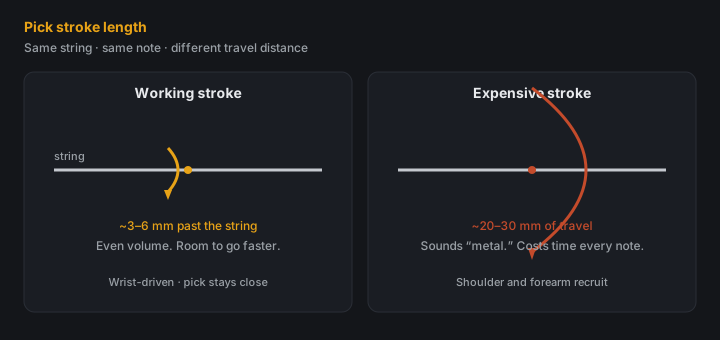
Anchor lightly if it helps stability (pinky on the body or floating). Neither is morally superior. Stability that does not choke the high strings is the test.
String crossing
Inside picking (moving toward the next string “into” the pick) and outside picking (moving around the next string) feel different. Most players leak time on outside crossings first. Isolate two-string groups: 6–5, 5–4, 4–3, and so on, at a tempo where both notes are the same length and volume. Full drill: outside string-crossing drill.
Practice ladder
- Single string, 8th notes, even volume, 60–80 BPM.
- Single string, 16ths, still even. If ups disappear, drop BPM.
- Two adjacent strings, four notes each, then two notes each.
- One note per string across three strings (the real test).
- Add accents on beats 1 and 3 without changing stroke size.
- Only then raise tempo 4–8 BPM when you can do 2–3 clean passes.